
Alaska Divorce Records
Alaska divorce records come from two official sources. The Alaska Court System holds the full case file for every divorce and dissolution filed in the state's 30 boroughs and census areas, including petitions, decrees, and all court documents. The Alaska Department of Health manages certified divorce certificates through its Vital Records section. Whether you need to search a case through CourtView, request a copy of a final decree from a local superior court, or order a certified certificate, the right path depends on what type of Alaska divorce record you need and where the case was originally filed.
Alaska Divorce Records at a Glance
Where Alaska Divorce Records Are Held
Alaska keeps divorce records in two distinct places, and knowing which to contact saves real time. The Alaska Court System maintains the full case file for every divorce and dissolution filed in the state. These files include the original petition or complaint, the final decree or judgment, all court orders, financial disclosures, and any other documents submitted during the case. These records are kept at the superior court where the case was filed. Alaska has court locations across its four judicial districts, with major hubs in Anchorage, Fairbanks, Juneau, and Kenai.
The Alaska Department of Health manages divorce certificates through its Health Analytics and Vital Records Section, known as HAVRS. Divorce certificates are only available if the parties filed form VS-401 with the court at the time of the divorce. That form triggers the registration of the divorce with Vital Records. Without it, the state may have no record of the divorce in its vital statistics system. If you need the divorce confirmed for a government agency, for remarriage purposes, or to update a name on official ID, the certificate is the standard document. But if you need the actual terms of the divorce, you need the decree from the court.
For copies of the decree, court orders, or the full case file, go to the superior court where the case was filed. For a certified one-page certificate, contact Vital Records directly or order through VitalChek online.
The Anchorage Superior Court directory handles more Alaska divorce cases than any other court in the state. It is at 825 W 4th Ave, Anchorage, and can be reached at (907) 264-0514. Record requests go to 3ANRecordsRequest@akcourts.us or by fax at (907) 264-0873.
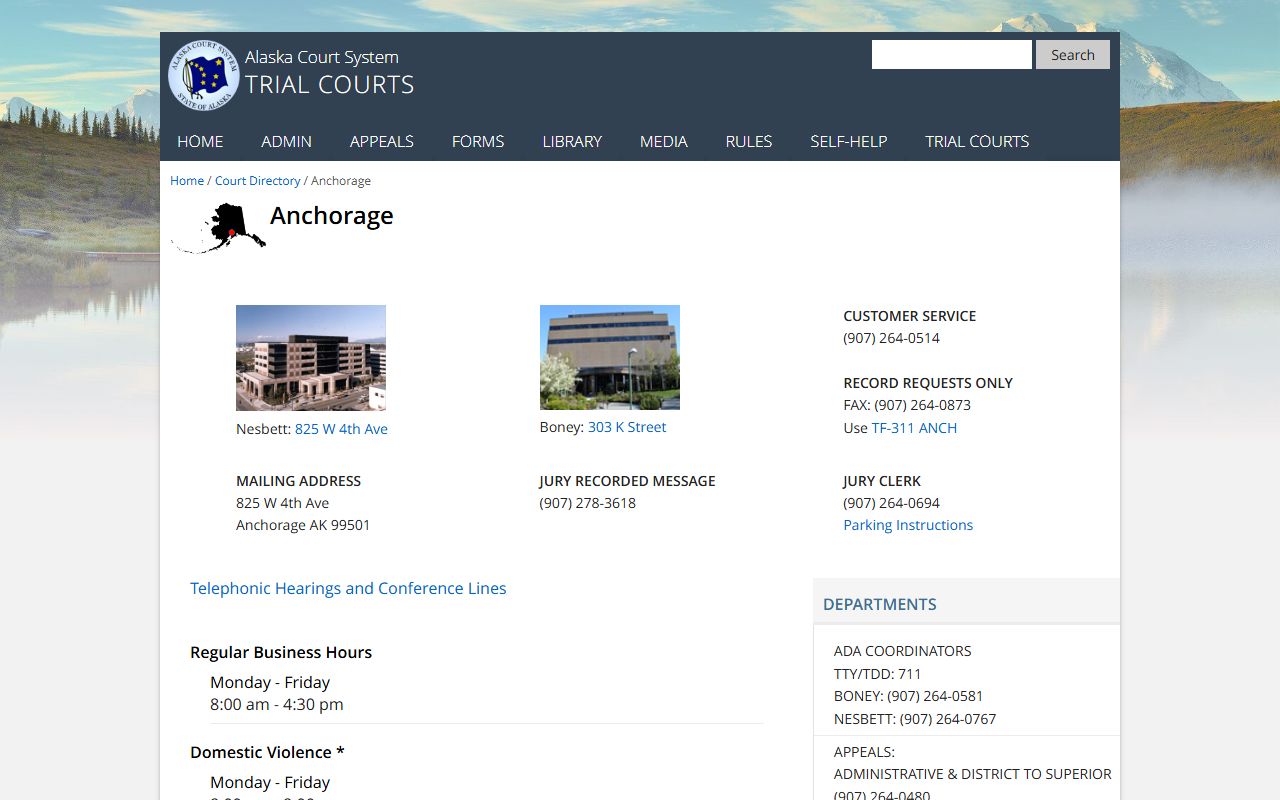
Anchorage divorce cases use the court prefix 3AN in the case number, followed by the year and CI suffix for civil and domestic filings entered after January 1, 1995.
The Alaska Vital Records orders page covers the full process for requesting certified divorce certificates, including fees, ordering methods, processing times, and what to do when a record is not on file.
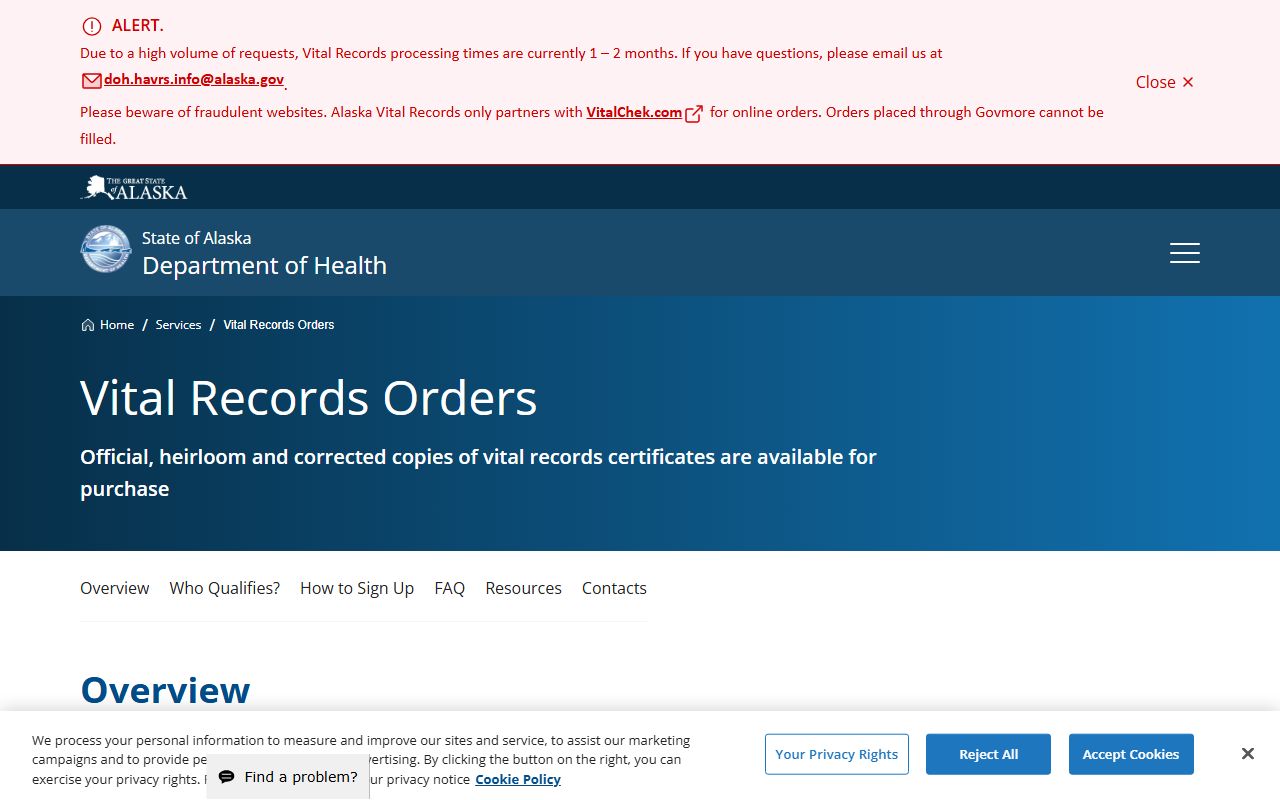
Vital Records offices operate in both Juneau and Anchorage for walk-in requests during regular weekday hours.
How to Search Alaska Divorce Records Online
CourtView is Alaska's free statewide online case search portal run by the Alaska Court System. Anyone can use it without a login or fee. You can search by party name or by case number. Results show the case number, party names, case type, hearing dates, and current status. CourtView does not display full document images. Think of it as a public index, not a document portal. Use it to find a case, confirm which court holds it, and get the case number before contacting the clerk for copies.
Alaska divorce cases filed before January 1, 1995 carry a DR suffix in the case number. Cases filed after that date carry a CI suffix. The format for all case numbers is: [Court Prefix]-[2-digit year]-[5-digit sequence number with leading zeros]-[Suffix]. For example, 3AN-24-00001CI is an Anchorage civil case from 2024. Court prefixes vary by location. Anchorage is 3AN, Fairbanks is 4FA, Juneau is 1JU, Kenai is 3KN, Bethel is 4BE, Sitka is 1SI, Ketchikan is 1KT, and Kodiak is 3KO. If you are searching an older case, try both the DR and CI suffix versions since the system may have indexed the same case differently depending on when it was entered.
CourtView returns up to 500 results per query. Common last names can produce many results, so adding an approximate year helps narrow things down. Case status shows as Open (active), Closed (final order entered), or Reopened (post-judgment activity such as a custody or support modification is underway).
Visit the CourtView public access portal to run a name or case number search at no cost.
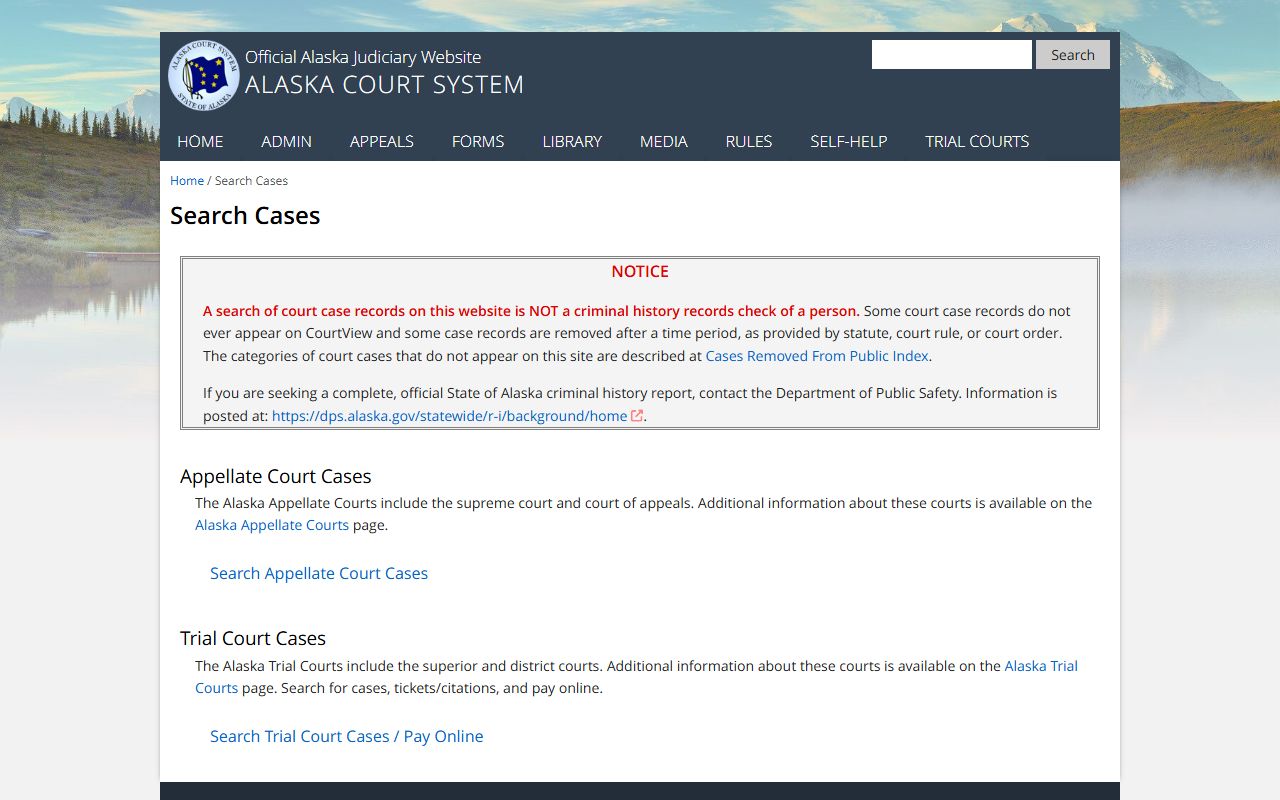
CourtView is available at any hour without registration and is the starting point for locating Alaska divorce case records.
The CourtView information guide explains how case numbers are formatted, which cases are excluded from the public index, how to read case status and financial dockets, and what each tab on the case detail screen contains.
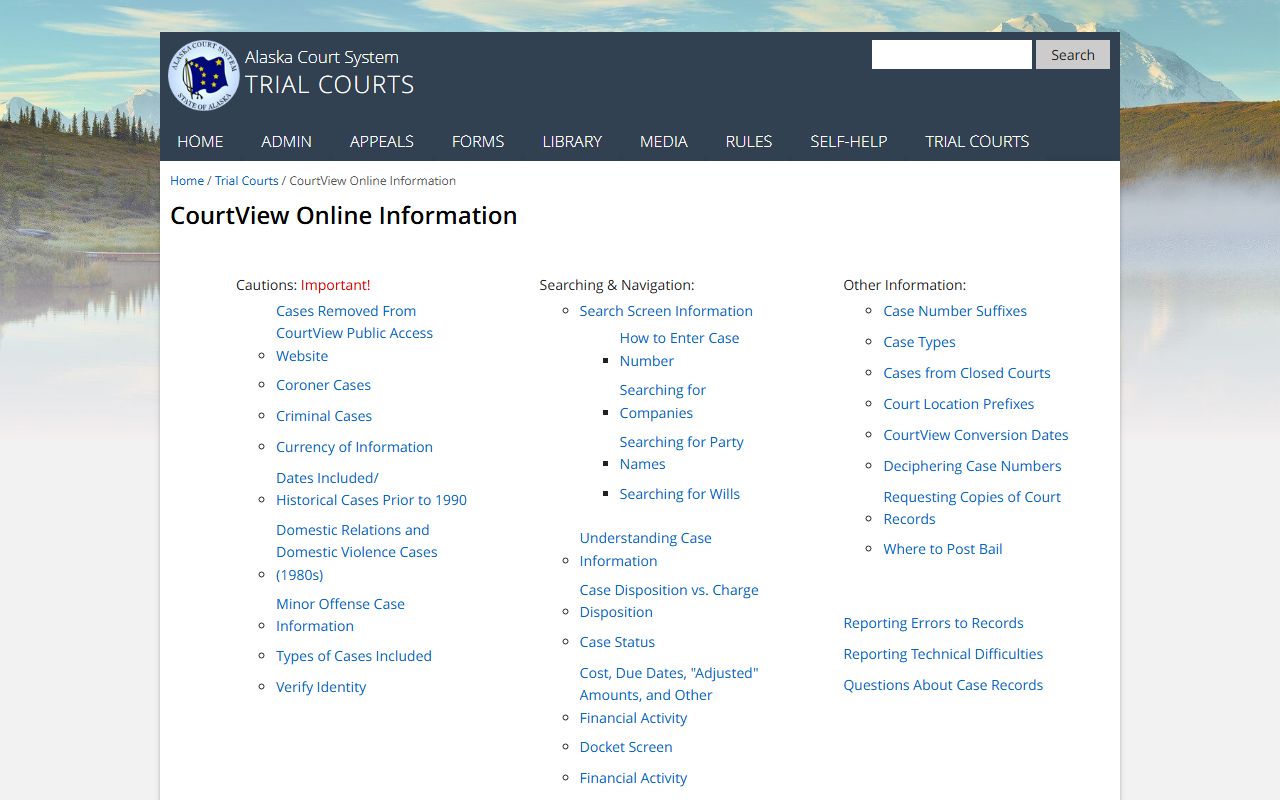
Cases that are sealed, confidential, or removed by court order do not appear in CourtView results, but most divorce and dissolution filings remain publicly searchable.
Types of Alaska Divorce Records
Three distinct types of records relate to ending a marriage in Alaska. Each one serves a different purpose and comes from a different source. Knowing which one you need before you start makes the process much faster.
A divorce record is the complete case file at the court. It holds every document filed during the proceedings: the original petition or complaint, the answer or waiver, financial disclosures, temporary orders, parenting plans, settlement agreements, and the signed final decree or judgment. For a simple dissolution with no property disputes, the file may be thin. For a contested divorce that went to trial, it can be several hundred pages. The full file is only available at the court where the case was filed.
A divorce decree is one specific document within the case file. The judge signs it to formally end the marriage. It summarizes all final terms: who gets which property, custody and parenting arrangements, child support amounts, spousal maintenance if any, and name change orders. This is the document most people need when proving they are divorced. Certified copies of the decree carry the court seal. They are valid for official purposes like changing your name on a driver's license or passport.
A divorce certificate is issued by the Alaska Department of Health, not the court. It is a one-page official document confirming who was divorced, when, and in which state. It does not include the terms of the divorce. For it to exist, the parties had to file form VS-401 with the court at the time of the divorce. Without that form, the divorce is not registered with Vital Records. In that case, a certified copy of the decree from the court is the next best option.
A typical Alaska divorce case file includes:
- Petition or complaint for divorce or dissolution
- Answer or waiver of service
- Financial disclosures and asset schedules
- Parenting plan or custody order (when children are involved)
- Temporary orders for support or property use
- Settlement agreement (for uncontested cases)
- Final decree or dissolution judgment signed by the judge
The Alaska Court System forms index lists all divorce and dissolution packet forms, including the VS-401 Certificate of Divorce, Dissolution of Marriage, or Annulment form required for registration with Vital Records.
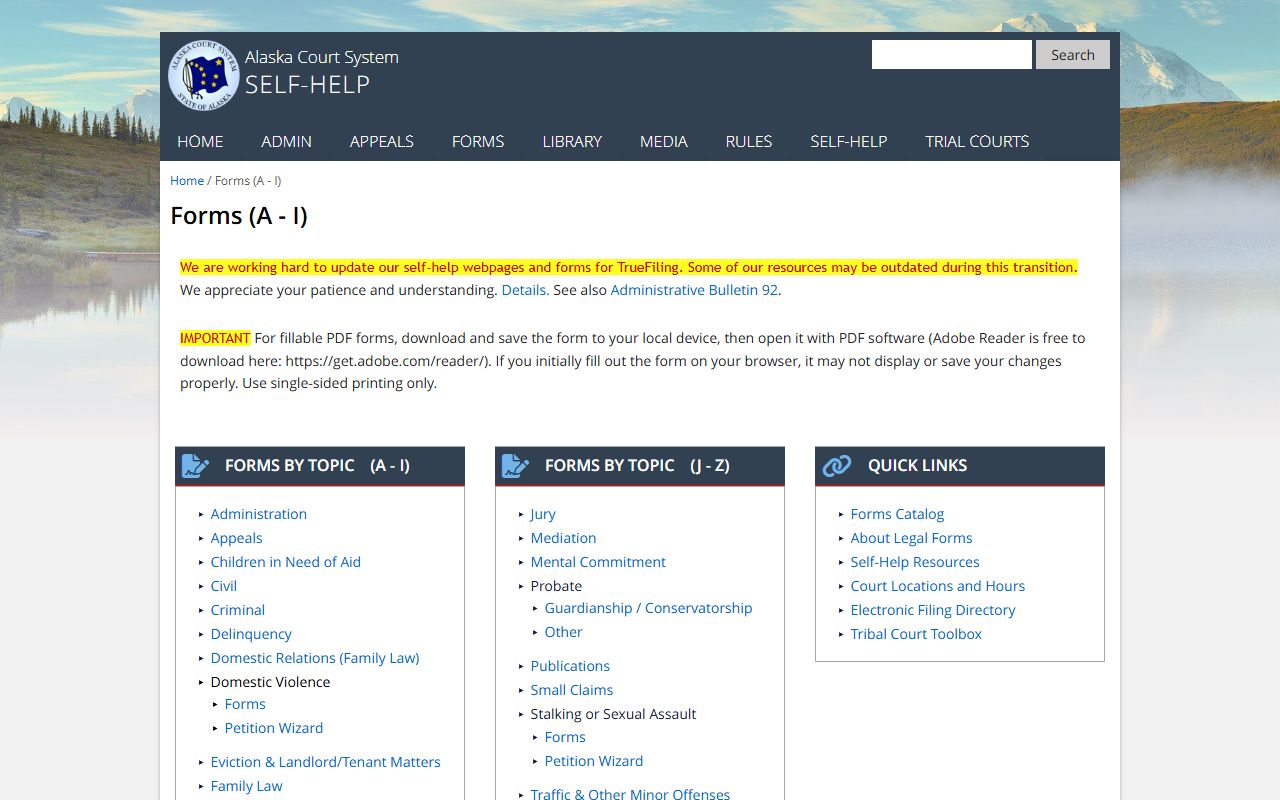
Filing VS-401 at the time of divorce matters because it is the only way to get a certificate through Vital Records later. Courts do not automatically submit it.
Note: If the VS-401 form was not filed at the time of the divorce, you may not be able to order a certificate through Alaska Vital Records even after 50 years.
Alaska Divorce Filing Fees and Costs
Filing for divorce or dissolution in Alaska costs $250. This fee has been in place statewide since May 1, 2023 and applies regardless of whether children are part of the case. The petitioner pays at the time of filing. Post-judgment modification motions have their own fee structure. If both parties agree and file jointly, a modification is free. If only one party files and the other has not agreed, the fee is $75.
Copy fees are separate from filing fees. The first certified copy of any court document is $10. Each additional certified copy of the same document, ordered at the same time, costs $3. Plain (non-certified) copies are $5 for the first document and $3 for each document after that in the same request. Research time, meaning when court staff must spend time locating older records, is billed at $30 per hour with a one-hour minimum. Audio recordings from hearings cost $20 per CD.
Divorce certificates from Alaska Vital Records cost $25 per copy. Additional copies of the same record, ordered in the same request, are also $25 each. Expedited service is available only through VitalChek and processes in 3-4 weeks excluding shipping. Mail and fax requests take 2-3 months for standard processing.
The Alaska court filing fees page shows the current official fee schedule for all types of family law filings, including divorce, dissolution, custody, name changes, and post-judgment modifications.
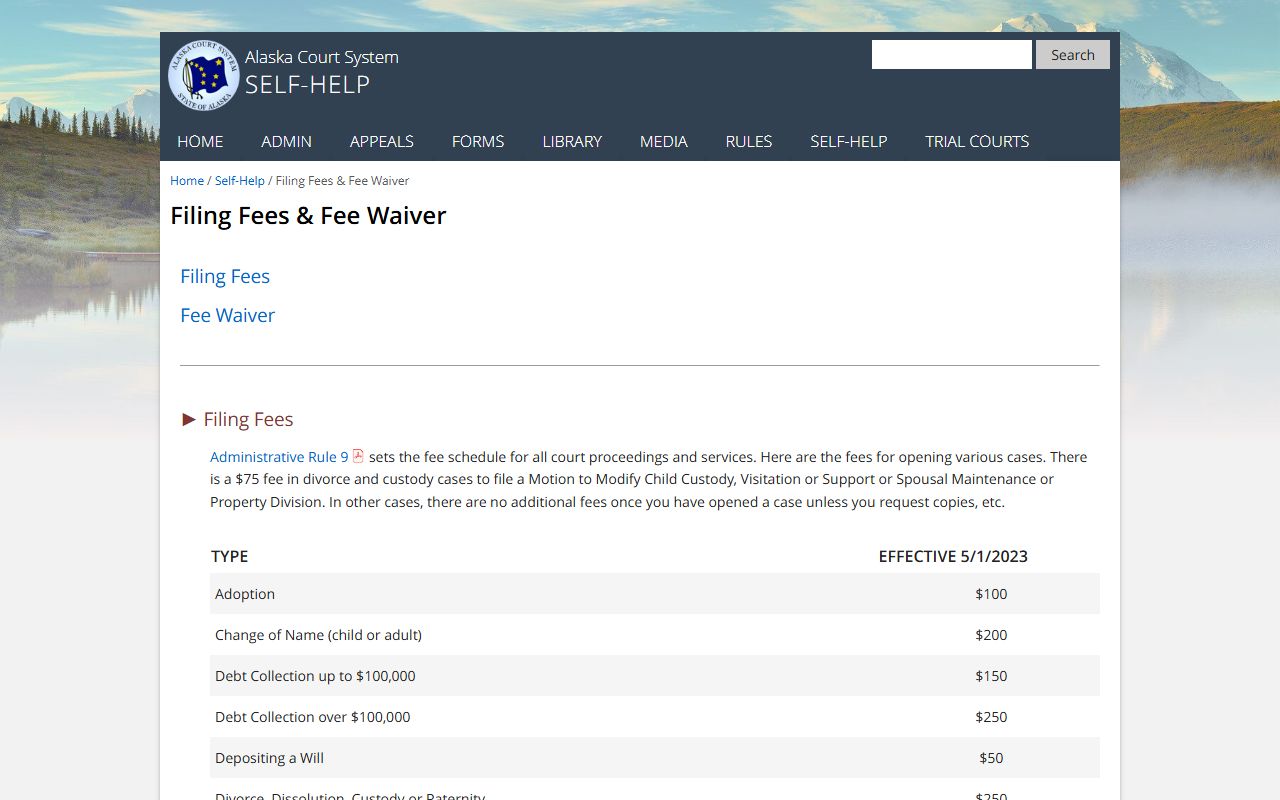
Filing fees are paid at the time of initial case filing and are non-refundable regardless of how the case ends.
Getting Copies of Alaska Divorce Records
To get a copy of any Alaska divorce record, contact the superior court where the case was filed. You can submit your request in person, by mail, by email, or by fax. Most locations use a standard records request form. The form number varies by court location:
- Anchorage, Saint Paul Island, and Sand Point: Use form TF-311 ANCH
- Fairbanks: Use form TF-311 FBKS
- Palmer: Use form TF-311 PA
- All other court locations: Use form TF-311
Processing times differ by location and how you submit the request. In-person requests at most courts are handled the same day. Fairbanks processes online and mail requests in 4-6 weeks. Palmer takes 2-4 weeks for online requests. The Valdez court currently takes 4-6 weeks due to staffing. If you need a certified copy quickly, going in person is the fastest option. Bring your ID. The clerk can pull the file and make copies while you wait in most cases.
Most divorce files are open to the public. You do not need to be a party to the case to request copies. Social security numbers and financial account numbers are redacted from copies provided to the public. Some financial source documents like tax returns may be under seal in individual cases. If you want to inspect the entire file, you can do so at the courthouse.
The Alaska trial courts page explains the records request process in full, including which form to use at each court, fee schedules, and what to expect for turnaround time.
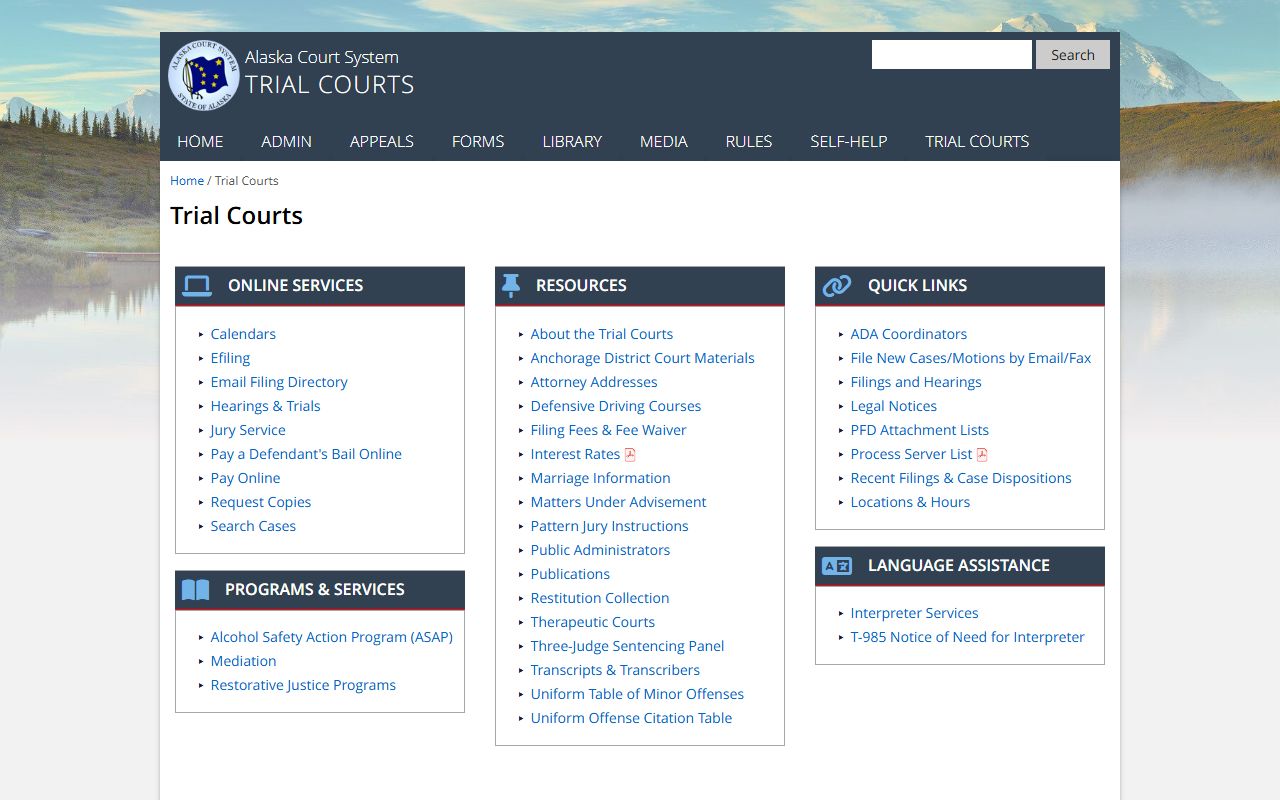
The page also describes how to request audio recordings from court hearings and provides guidance on cases involving financial judgment collections.
Divorce and Dissolution Under Alaska Law
Alaska law gives couples two legal paths to end a marriage. Divorce, governed by AS 25.24.160, is for situations where the parties cannot agree on everything. One spouse files a complaint and the other has 20 days to respond. If an agreement is reached before the hearing, the court can enter a decree. If not, the case may go through mediation as provided under AS 25.24.060, and ultimately to a hearing or trial if necessary. Contested divorces typically take six months to a year or more.
Dissolution under AS 25.24.230 is available when both spouses agree on all issues related to the end of the marriage. Both parties file a joint petition. The court reviews the agreement to confirm it is fair to both sides. Under AS 25.24.220, the court gives heightened review to agreements where one party is unrepresented, where domestic violence is in the picture, where minor children are involved, or where the property split looks unequal. Dissolution hearings can be scheduled as soon as the 30-day waiting period passes. The 30-day minimum wait under AS 25.24.220 applies to both divorce and dissolution. A judge will generally not sign the final decree until at least 30 days have passed since filing.
Residency is required to file in Alaska. At least one spouse must be an Alaska resident. Active military members stationed in Alaska are treated as residents for filing purposes. Alaska does not specify a minimum duration for how long someone must have lived in the state before filing.
Name changes in connection with a divorce are governed by AS 25.24.165. A party can request a name change as part of the divorce or dissolution proceeding. The court can include it in the final decree. For voidable marriages and grounds for annulment, see AS 25.24.030.
The full text of Alaska's family law statutes is at Alaska Statutes Title 25, which covers everything from filing requirements and waiting periods to property division, custody, and post-judgment modifications.
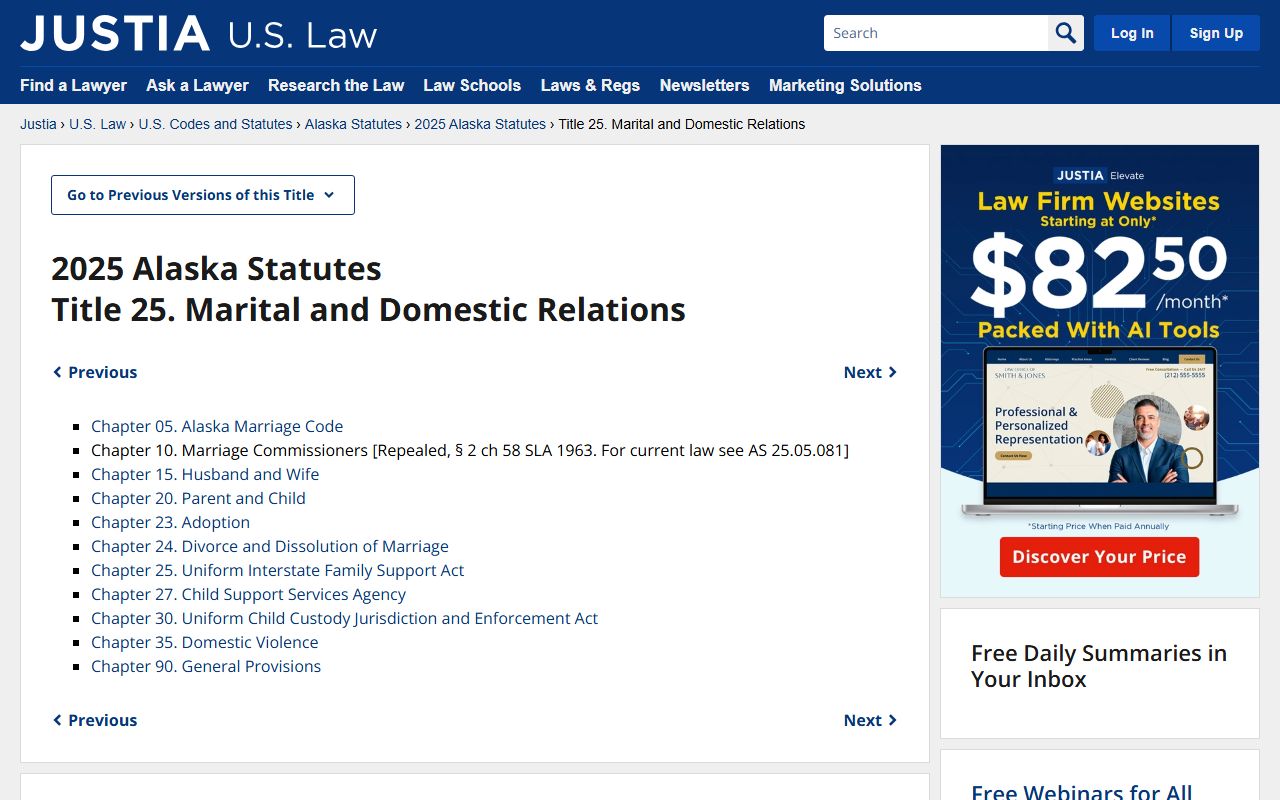
Title 25 is the primary legal framework for all Alaska family law matters, including divorce, dissolution, custody, child support, and spousal maintenance.
The Alaska Court System's guide to starting a divorce or dissolution case walks through the entire process step by step, from determining residency to filing the initial petition to attending the final hearing.
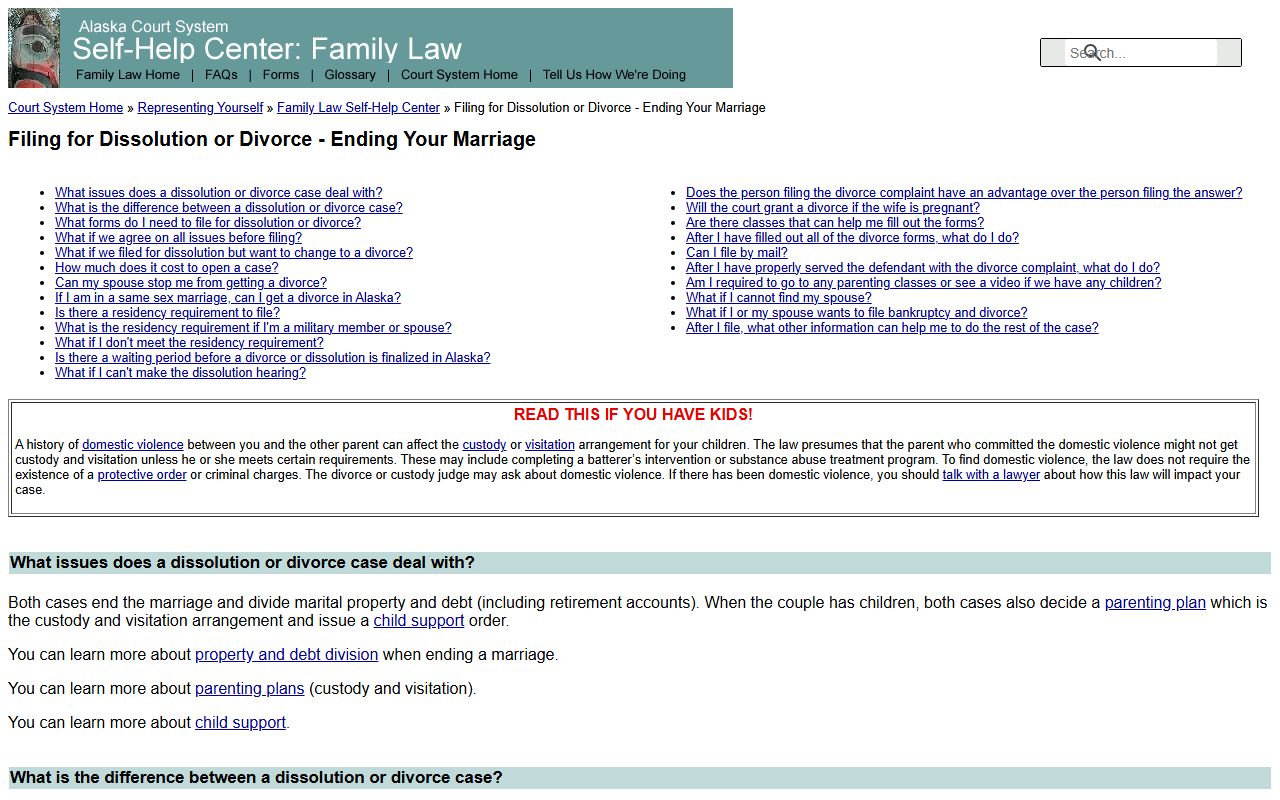
The guide also explains the timing rules, how to handle service of process, and what to expect if your case is contested.
Ordering Alaska Divorce Certificates from Vital Records
Alaska divorce certificates are certified one-page documents issued by the Department of Health. They confirm who was divorced, when, and in which state. These are not the same as court decrees. Certificates show basic facts only and do not include property division, custody terms, or other details from the case. They are commonly used for administrative purposes like changing a name on a Social Security card, driver's license, or passport, or for remarriage applications.
Access to divorce certificates is restricted for 50 years from the date of the divorce. During that period, only the people named on the certificate, their legal representatives, or people who can prove a legal entitlement can order one. You must state your relationship to the parties when submitting any request. After 50 years, the records become fully public and anyone can order a copy.
There are three ways to order. You can visit in person at the Anchorage office (3901 Old Seward Hwy, Suite 101, phone (907) 269-0991) or the Juneau office (5441 Commercial Boulevard, phone (907) 465-3391). Both offices are open weekdays from 8:30 AM to 4:30 PM. You can also order online through VitalChek, or mail or fax a request to the Juneau location using the downloadable order form. Use only one method per request to avoid duplicate orders and duplicate charges. For questions about an order in progress, contact the records processing unit at BVSOffice@alaska.gov. For certificates that are not registered with the state, contact BVSRegistration@alaska.gov.
The Health Analytics and Vital Records Section main page provides full details on ordering vital records, understanding eligibility restrictions, and navigating the state's vital statistics system.
HAVRS also handles corrections to existing vital records and manages the state's annual vital statistics reporting, which includes statewide divorce and separation data.
Note: If a divorce does not appear in the Vital Records system, the VS-401 form was likely never submitted to the court at the time of the divorce.
Family Law Help for Alaska Divorce Cases
The Alaska Court System's Family Law Self-Help Center assists people who want to handle their own divorce or dissolution without an attorney. It offers forms, step-by-step instructions, and guidance on every stage of a family law case, from initial filing through post-judgment modifications. Topics covered include divorce, dissolution, custody, child support, paternity, and property and debt division. The statewide phone number is (907) 264-0851. Outside the Anchorage area, the toll-free number is (866) 279-0851.
Alaska Legal Services Corporation runs free divorce and custody clinics at several locations across the state. These clinics serve people who qualify based on income. They help with form completion, explain court procedures, and connect people with volunteer attorneys for more complex matters.
Visit the Family Law Self-Help Center for forms, instructions, and guidance on every stage of an Alaska divorce or dissolution case.
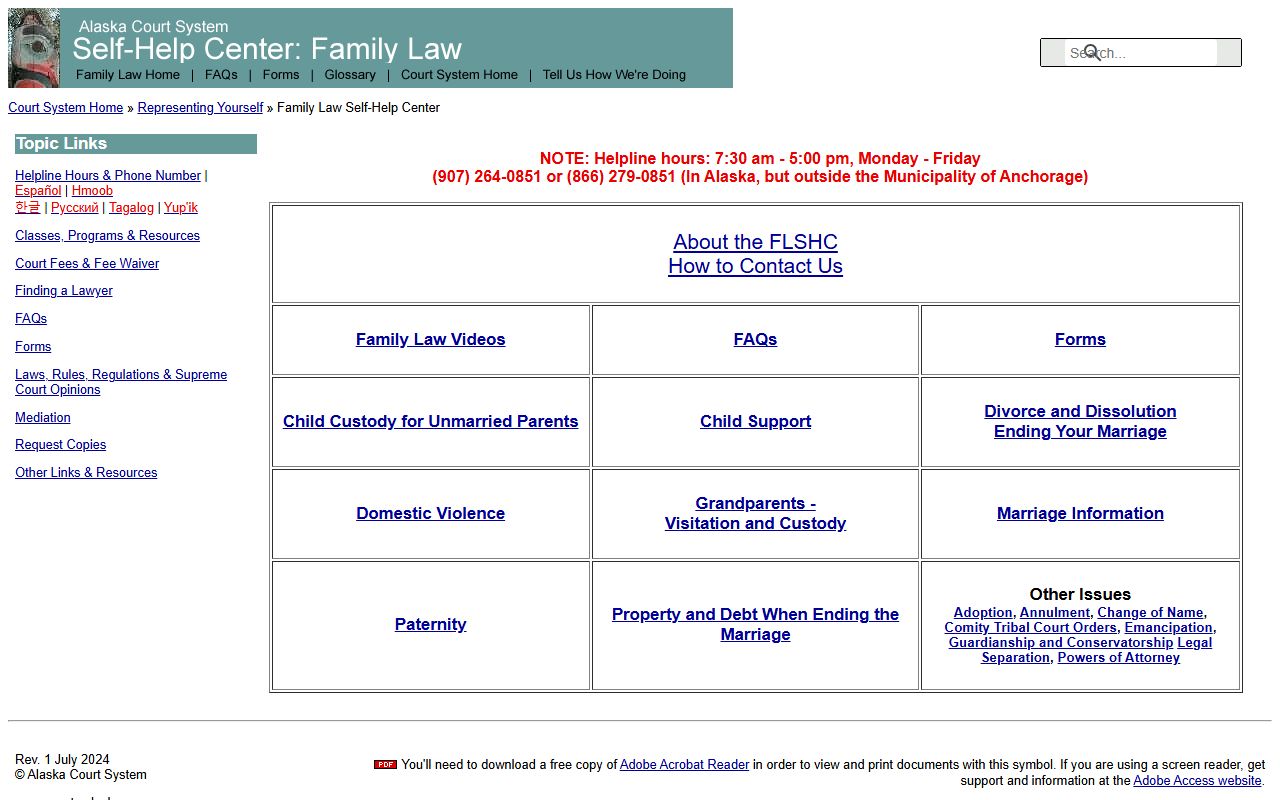
The center also provides information on telephonic appearance options for people who are unable to attend dissolution hearings in person.
Alaska Court Locations for Divorce Filings
Alaska's superior courts handle all divorce and dissolution cases. The state is divided into four judicial districts, each with at least one primary superior court. The Third Judicial District, based in Anchorage, processes the largest share of all divorce filings in Alaska. The 2024 vital statistics report recorded 1,036 separations in the Anchorage region, a rate of 3.6 per 1,000 residents. The Interior region centered in Fairbanks had the highest separation rate in the state at 4.0 per 1,000. Mat-Su logged 364 separations (3.1 per 1,000), and the Southeast region had 180 (2.5 per 1,000).
The Fairbanks Superior Court serves the Fairbanks North Star Borough and the broader Interior region, including Denali Borough, Southeast Fairbanks Census Area, and Yukon-Koyukuk Census Area. It is at 101 Lacey Street, Fairbanks, phone (907) 452-9277. Record requests go to 4FArecords@akcourts.gov or by fax at (907) 452-9330. Online records requests take 4-6 weeks. In-person requests are handled the same day. The court is closed Wednesdays from 8:00 to 9:00 AM but otherwise open weekdays.
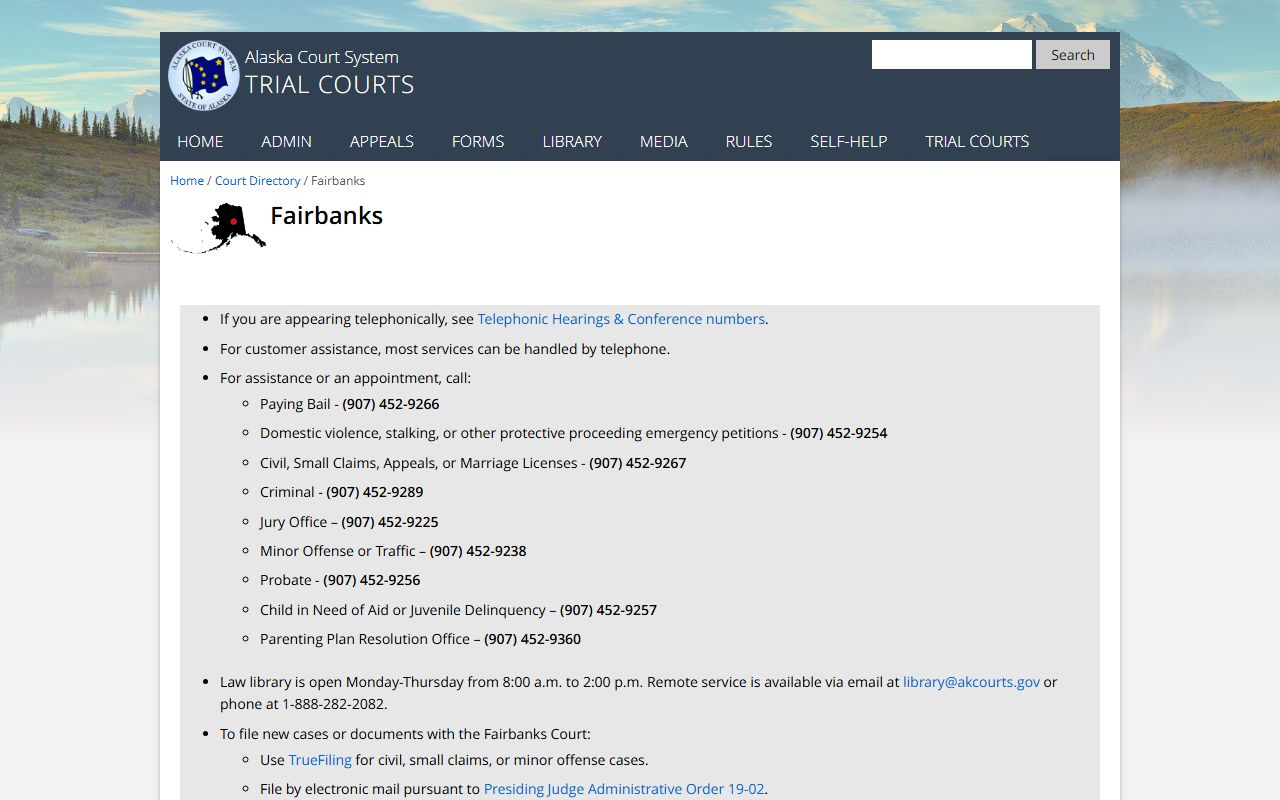
Fairbanks cases use the 4FA prefix and the court also maintains a law library open Monday through Thursday from 8:00 AM to 2:00 PM, reachable remotely at library@akcourts.gov or 1-888-282-2082.
The Juneau Superior Court handles divorce cases for the First Judicial District, covering all of Southeast Alaska including Juneau, Sitka, Ketchikan, Haines, Petersburg, Wrangell, and Skagway. Located at 123 4th Street, Juneau, the court can be reached at (907) 463-4700. Record requests go to 1JUmailbox@akcourts.gov or by fax at (907) 463-3788. The Alaska Vital Records Juneau office at 5441 Commercial Boulevard is nearby.
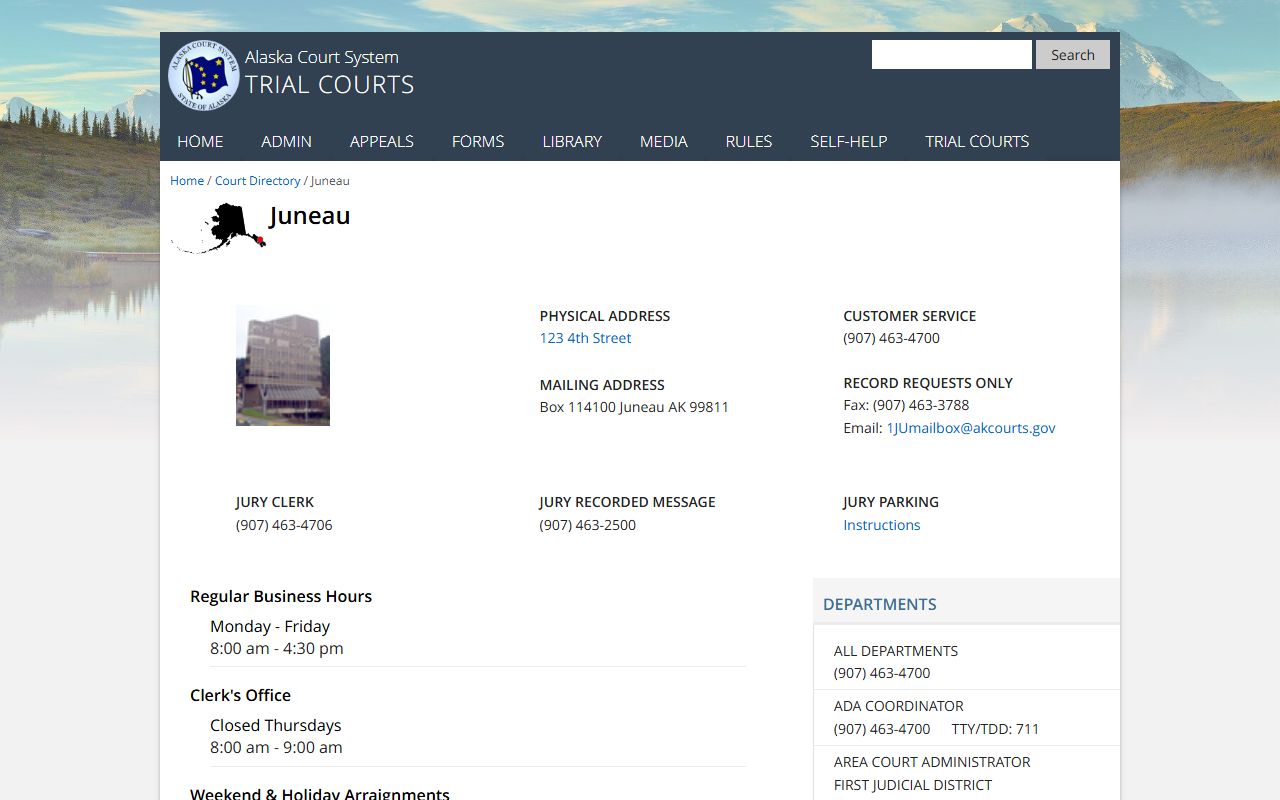
The Juneau court is closed Thursday mornings from 8:00 to 9:00 AM, and all Alaska courts observe standard state holidays.
When You Cannot Locate Your Spouse to File
Filing for divorce requires serving the other party with court papers. If you do not know where your spouse is, the Alaska Court System provides a guide with practical steps for finding them. Standard approaches include checking the last known address, contacting mutual friends or relatives, reaching out to known employers, searching online directories, and looking up utility records through municipal departments. Military members can be located through the SCRA database.
The Alaska Court System's guide on locating people lists specific resources, websites, and steps for finding a spouse when standard attempts have not worked.
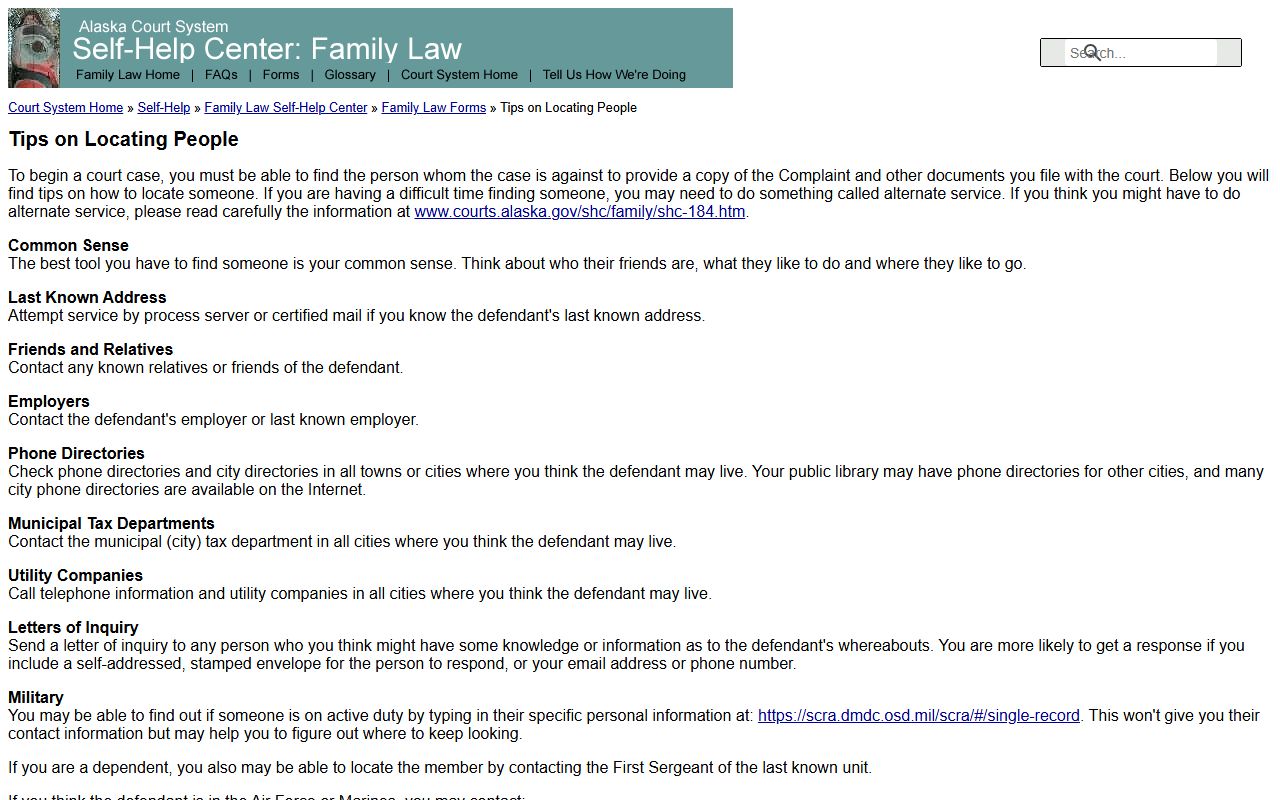
If reasonable efforts to locate your spouse fail, you may petition the court for permission to serve by publication, which allows the divorce to proceed in certain circumstances even when the respondent cannot be found.
Are Alaska Divorce Records Public
Yes. Most Alaska divorce case files are open to the public under the Alaska Public Records Act, codified at AS 40.25.100 through 40.25.295. Public agencies, including court clerks, must disclose records unless they are protected by statute, sealed by court order, or covered by a specific statutory exception. Divorce case files generally do not fall into any protected category, and anyone can request copies from the clerk of the court where the case was filed. You do not need to give a reason, and you do not have to be a party to the case.
Some parts of a divorce file may have limited access. Social security numbers and financial account numbers are redacted from public copies. Detailed financial documents like tax returns or bank statements may be placed under seal. Records about minor children, including custody evaluations and guardian ad litem reports, can have restricted access. Any party can petition the court to seal specific records, but the judge must approve after weighing the privacy interest against the public interest in open records.
Divorce certificates from Vital Records are restricted for 50 years from the date of the event. Court case files and decrees do not carry the same restriction and are available to the public without any waiting period.
Browse Alaska Divorce Records by Borough
Alaska is divided into 30 boroughs and census areas. Each falls under one of four judicial districts, and each has a superior court that handles divorce filings. Select a borough or census area below to find local court contact info, filing resources, and guidance for finding Alaska divorce records in that area.
View All 30 Alaska Boroughs & Census Areas
Alaska Divorce Records in Major Cities
Major cities in Alaska file divorce cases at the superior court serving their borough or census area. Select a city below to find the right court location, contact information, and local resources for Alaska divorce records in your area.